



- 2026 solar eclipse
- August 12 2026 eclipse
- total solar eclipse 2026
- solar eclipse path 2026
- where to see solar eclipse 2026
- 2026 eclipse Europe
- Iceland solar eclipse 2026
- Spain solar eclipse 2026
- how to watch solar eclipse
INTRODUCTION
On August 12, 2026, the Moon will pass directly between Earth and the Sun, casting a shadow that will plunge parts of the planet into daytime darkness. This total solar eclipse marks the first time totality has been visible in Iceland since 1954 and the last time it will be seen there until 2196 .For observers in Spain, Iceland, and Greenland, this eclipse stands out as the most significant astronomical occurrence in many years.Across the northern United States, Canada, Europe, and northwestern Africa, viewers will witness a dramatic partial eclipse that will transform the Sun into a brilliant crescent.
📚 TABLE OF CONTENTS
- What Makes the August 2026 Total Solar Eclipse So Special
- The Path of Totality: Where to See the Full Eclipse
- What Happens During a Total Solar Eclipse
- How to Watch the Eclipse Safely
- The 2026 Eclipse and the Battle Against Superstition
- Conclusion
- Frequently Asked Questions
1. What Makes the August 2026 Total Solar Eclipse So Special
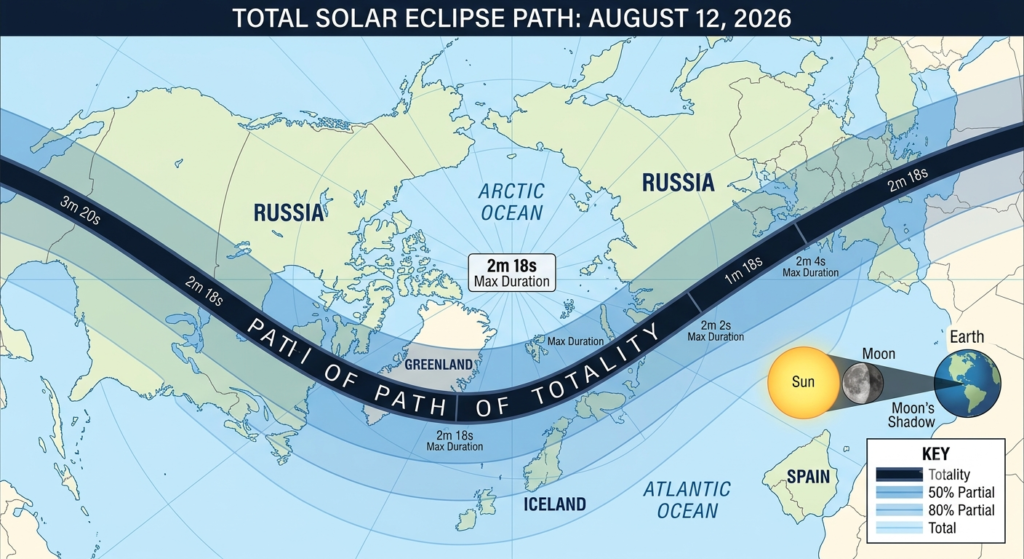
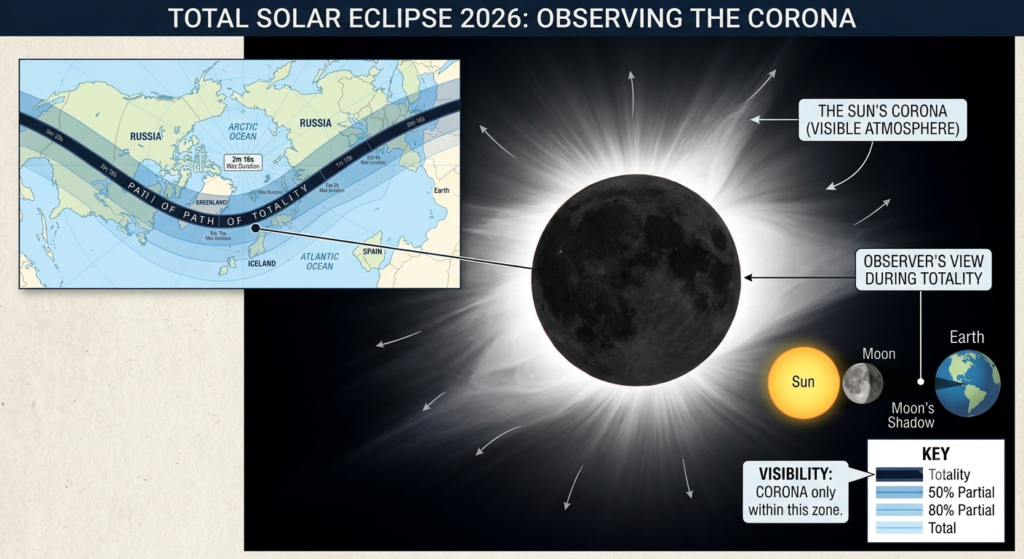
The August 2026 solar eclipse is notable for several reasons. The path of totality will stretch from Russia’s Taymyr Peninsula across the Arctic Ocean, skirt the North Pole, and sweep down along Greenland’s eastern coast before reaching Iceland and the northern coast of Spain .
For locations in the eclipse’s path, the total phase will last between one and two minutes. Reykjavík, Iceland, will experience 57 seconds of totality, while the maximum duration reaches 2 minutes and 18 seconds near Greenland’s eastern coast . By comparison, the longest solar eclipse of the century will reach 6 minutes and 23 seconds in a different path—a significantly longer event that has generated its own set of concerns .
The 2026 eclipse is also the first total solar eclipse visible from Europe since 2015, which has generated tremendous anticipation among eclipse-chasers and casual observers alike .
2. The Path of Totality: Where to See the Full Eclipse
The total solar eclipse will begin in Russia around midday before sweeping eastward across the Arctic Ocean. It will pass just south of the North Pole and make landfall in northeastern Greenland just after 4.00 PM local time .
From Greenland, the Moon’s shadow will race along the eastern coast at over 3,400 kilometers per hour before crossing into the Atlantic Ocean. Iceland will be the first heavily populated area to experience totality since the eclipse began in remote regions only accessible to researchers and eclipse-chasers .
After skimming the western coast of Iceland, the total eclipse will cross the ocean again and reach land in northern Spain just before 8.30 PM local time. The path will also graze the northeast corner of Portugal and cross the Balearic Islands off Spain’s east coast before the Sun sets and the eclipse concludes .
The Partial Eclipse Viewing Area
While totality will be visible in only a few areas, a partial eclipse will sweep across roughly a quarter of the planet. This partial eclipse will be visible across:
- Across the northern parts of the United States and throughout Canada
- Much of Europe
- Northwestern Africa
- Parts of the UK
In London, observers will experience a 91 percent partial eclipse, while Oslo will see 83 percent coverage . For many people, this will be their first time witnessing the Moon take a “bite” out of the Sun.
3. What Happens During a Total Solar Eclipse
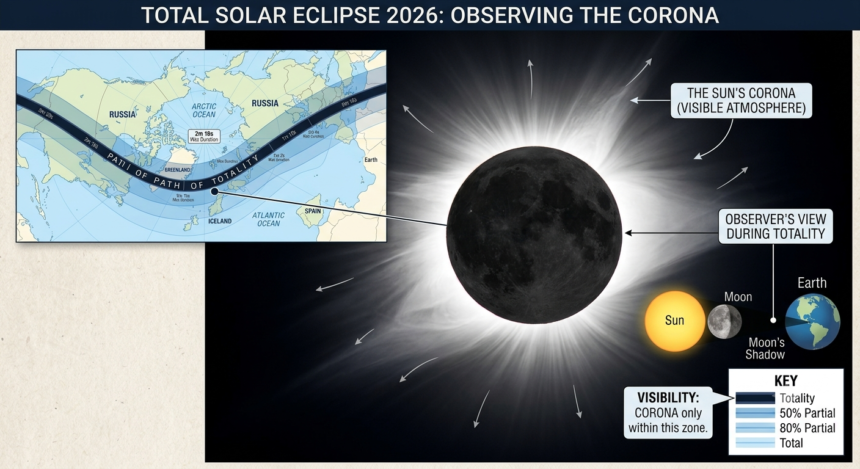
During totality, when the Moon completely covers the Sun’s disk, remarkable changes occur in the environment. Temperatures on the ground drop by several degrees, and daytime transforms into twilight .
The Sun’s outer layer, referred to as the corona, becomes visible without any special equipment once the Sun is fully covered.Usually, the corona is completely lost in the glare from the Sun’s far brighter inner regions. But when the Sun’s disk is blocked, its shimmering sheets of extraordinarily hot plasma become briefly visible .
As totality ends, a brilliant flash of light—called the diamond ring effect—signals the Sun’s return. This occurs when the first sliver of the Sun peeks around the Moon, creating a stunning visual that resembles a diamond set in a ring.
Partial Eclipse Experience
During a partial eclipse, the ambient light levels and temperatures won’t drop as dramatically as they do during totality. The corona will not become visible, and the full effect of daytime darkness won’t occur. However, for many observers, watching a significant portion of the Sun’s disk covered remains an unforgettable experience .
4.How to Watch the Eclipse Safely
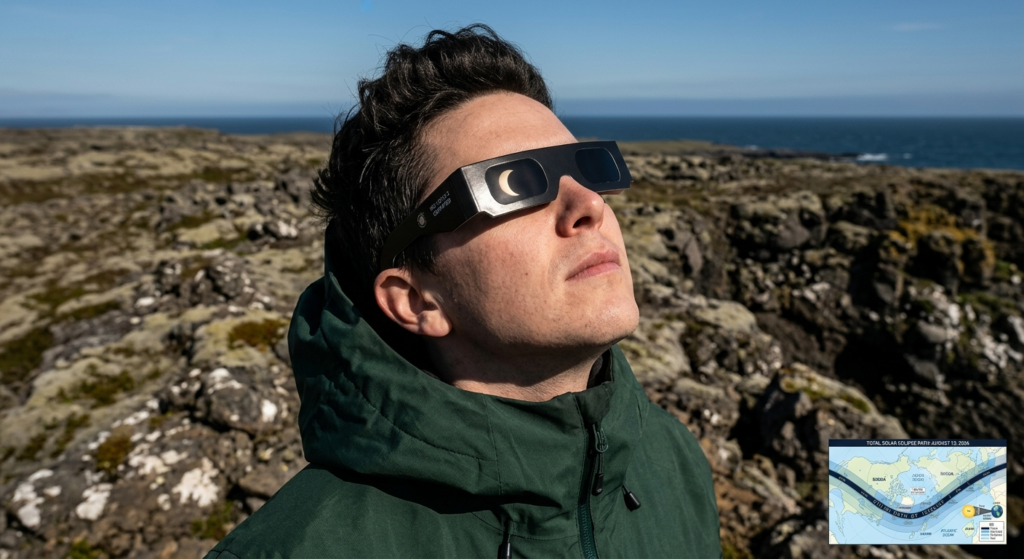
The most important rule of solar eclipse viewing is never looking directly at the Sun without proper eye protection. During partial phases of the eclipse, viewing the Sun without protection can cause serious and permanent vision damage .
Safe Viewing Methods
- Eclipse Glasses:
Special-purpose solar filters, commonly called eclipse glasses, are essential for safe viewing.Everyday sunglasses, including very dark pairs, are not safe for viewing the Sun and should never be used during an eclipse.Welding helmets with shade level 14 or higher are also safe alternatives .
- Indirect Viewing:
If you don’t have proper eye protection, you can watch the eclipse without looking directly at the Sun. A pinhole camera or even natural shadows can create a projection of the Sun’s shape, showing the Moon’s progression across the solar disk. This method is safe and easy to set up .
- Live Broadcasts:
Many observatories and astronomical institutes will provide live streams of the eclipse, which may be the best option if you cannot obtain proper viewing equipment .
The One Exception: Totality
During the brief period of totality, when the Sun is completely covered, it is safe to look at the corona with the naked eye. However, you must be absolutely certain that the eclipse is in totality—even a small sliver of the Sun’s disk is enough to cause permanent retinal damage .
5. The 2026 Eclipse and the Battle Against Superstition
While scientists celebrate the astronomical significance of the 2026 eclipse, some researchers worry about a parallel phenomenon: misinformation and cultural panic .
The “longest eclipse of the century” designation has fueled fears ranging from crop failures to cursed pregnancies. Rumors have spread through group chats and social media, with messages claiming authorities are warning about mass panic, ritual gatherings, or spiritual dangers .
In some areas, posters have appeared at medical clinics warning pregnant women not to travel alone during the eclipse. Temple courtyards are selling blessed amulets and protective ash. School administrators are being advised to keep children indoors—not for eye safety, but to prevent “spiritual contamination” .
Scientists emphasize that eclipses are simply orbital mechanics—a predictable alignment of the Sun, Moon, and Earth. The only real danger is eye damage. There is no scientific evidence supporting claims of crop failures, cursed pregnancies, or any other supernatural effects .
6.Conclusion
The August 12, 2026 total solar eclipse will be a remarkable event for millions of observers across the northern hemisphere. For the first time in over 70 years, Iceland will experience totality, while Spain and Greenland offer unique viewing opportunities in the path of the Moon’s shadow.
Whether you travel to the path of totality or watch a partial eclipse from your own backyard, the experience of witnessing the Moon cover the Sun is one that stays with you forever. The next total solar eclipse in Europe will not occur until 2027, and the next opportunity in Iceland won’t arrive until 2196 . This makes the August 2026 event truly a once-in-a-generation experience.
Remember to observe proper safety precautions, enjoy the wonder of nature’s great cosmic alignment, and help spread accurate information about what eclipses really are—predictable, beautiful, and entirely safe when viewed with the right protection.
FREQUENTLY ASKED QUESTIONS
1. When is the 2026 total solar eclipse?
The total solar eclipse will occur on August 12, 2026, with the path of totality moving from Russia across the Arctic to Greenland, Iceland, and Spain .
2.Which places will experience the total solar eclipse?
Totality will be visible in northeastern Greenland, Iceland, and northern Spain. Partial eclipse will be visible across the northern United States, all of Canada, much of Europe, and northwestern Africa .
3.How long will the eclipse last?
The maximum duration of totality will be about 2 minutes and 18 seconds near Greenland’s eastern coast. Reykjavík will experience 57 seconds, and Spain will see approximately 1.5 to 2 minutes of totality .
4.Can you look directly at the Sun during the eclipse?
Only during totality. During partial phases, you must use specially certified eclipse glasses or solar filters. Improvised tools like sunglasses, x-ray films, or CDs do not provide proper eye protection .
5. Can I watch the eclipse without glasses?
Yes, you can use indirect methods like a pinhole camera or shadow projection. Many observatories will also offer live broadcasts of the event .