




- Rare earth metals
- Future technology
- China rare earths
- Strategic minerals
Introduction: The Unsung Heroes of Modern Technology
While their names might sound like something from a science fiction novel – dysprosium, neodymium, cerium – rare earth metals are actually the silent power behind our modern technological world. These 17 strategic elements have become the cornerstone of everything from smartphones to military equipment, making them one of the most crucial resources in today’s global economy.
What Exactly Are Rare Earth Metals?
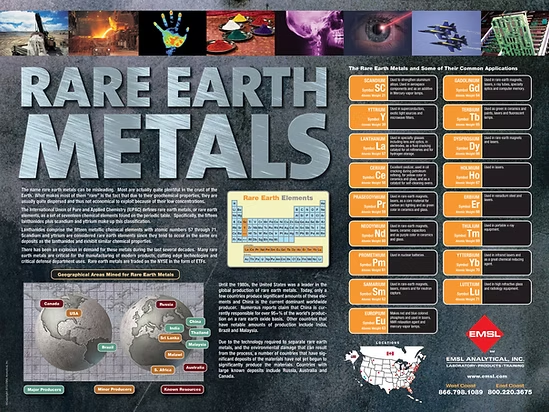
Contrary to their name, rare earth metals are relatively abundant in the Earth’s crust. The “rare” designation comes from their scattered distribution and the complex, environmentally challenging process required to extract and refine them. These 17 elements include the lanthanide series plus scandium and yttrium, each possessing unique magnetic, luminescent, and electrochemical properties that make them indispensable in modern technology.
Critical Applications in Today’s Technology
The importance of rare earth metals spans across virtually every high-tech sector:
Electronics: Neodymium enables the miniaturization of speakers and hard drives
Renewable Energy: Permanent magnets containing dysprosium and neodymium are essential for wind turbines and electric vehicles
Defense Systems: Precision-guided weapons and communication systems rely on rare earth elements
Medical Technology: MRI machines and various medical imaging equipment use rare earth magnets
Consumer Goods: From smartphones to LED lights, these metals are everywhere in daily life
The Global Supply Chain Challenge
Currently, China dominates the rare earth market, controlling approximately 80-90% of global refining capacity. This dominance gives Beijing significant geopolitical leverage, as demonstrated by recent export restrictions on rare earth processing technologies. The United States Geological Survey estimates global reserves at 110 million tonnes, with China holding the largest share at 44 million tonnes, followed by Vietnam (22 million) and Brazil (21 million).
Environmental and Production Challenges
The extraction and processing of rare earth metals present significant environmental hurdles:
1. Toxic chemical usage in separation processes
2.Radioactive waste byproducts from some ore types
3.Large volumes of rock must be processed for small yields
4.High energy consumption throughout the production chain
These environmental concerns have led many countries to outsource production, further consolidating China’s dominant position in the market.
Geopolitical Implications and Trade Dynamics
The strategic importance of rare earth metals has turned them into a geopolitical bargaining chip. Recent moves by China to restrict technology exports related to rare earth processing have sparked concerns about supply chain security. The US Treasury Secretary’s characterization of the situation as “China versus the world” underscores the high-stakes nature of these resources.
Diversification Efforts and Future Solutions
Nations worldwide are implementing strategies to reduce dependence on single sources:
United States: Reviving domestic production at sites like Mountain Pass, California
Japan: Investing in recycling technologies and alternative suppliers since 2010 supply shocks
European Union: Funding research into substitution materials and circular economy approaches
Australia: Expanding mining operations through companies like Lynas
The Road Ahead: Innovation and Sustainability
The future of rare earth metals lies in developing more sustainable solutions:
Improved recycling technologies to recover metals from electronic waste
Research into alternative materials with similar properties
Development of cleaner extraction and processing methods
International cooperation to ensure stable supply chains
Conclusion: Balancing Progress and Security
Rare earth metals represent a classic double-edged sword: they enable technological progress while creating strategic dependencies. As we move toward an increasingly digital and green future, ensuring secure, ethical, and sustainable access to these critical materials will be one of the defining challenges of our time. The nations that successfully navigate this complex landscape will likely lead the next wave of technological innovation.
Question for Readers :
Given the environmental challenges of mining and geopolitical tensions around supply chains, what strategy do you think is most viable for ensuring sustainable access to these critical metals in the future? Share your perspective below!